
Configuring Expression Columns in Bold BI Dashboard Designer
An expression column lets you create custom calculations without modifying the original data. By combining data columns, operators, and built-in functions, you can generate calculated values that can be used as quantitative measures in widgets.
Expression Types
You can create expressions in the following ways:
-
Data Source Expressions
-
Dashboard Expressions.
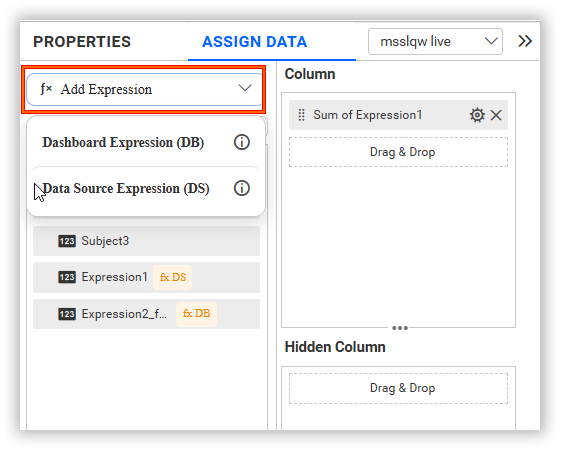
To create either a Data Source Expression or a Dashboard Expression, click the Add Expression icon in the dashboard design view, as shown in the following image.
Data Source Expressions
Data Source Expressions are created and managed at the data source level. They are stored as part of the data source configuration and are available in any dashboard that uses the data source.
Only users with permission to access and edit the data source can create or modify Data Source Expressions. Existing Data Source Expressions can be used by all users who have access to the dashboard.
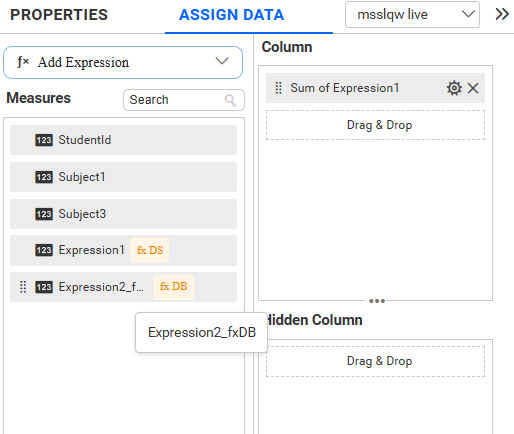
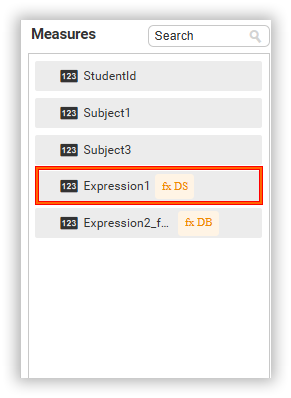
Note: Data Source Expressions retain their original expression names and do not include any suffix. In the user interface, they are identified with the DS indicator.
Dashboard Expressions
Dashboard Expressions are created and managed at the dashboard level for a selected data source. These calculated fields are stored as part of the dashboard configuration and are available only within that dashboard.
Dashboard Expressions enable dashboard authors to create custom calculations without modifying the underlying data source. They can be created and managed even by users who do not have permission to edit the data source, provided they have permission to edit the dashboard.
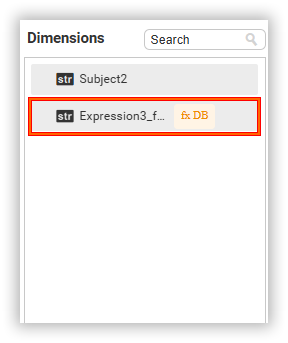
Note: Dashboard Expressions are internally identified by the _fxDB suffix appended to the expression name. In the user interface, they are identified with the DB indicator.
Key Differences Between Data Source Expressions and Dashboard Expressions
| Data Source Expressions (DS) | Dashboard Expressions (DB) | |
|---|---|---|
| Created At | Data source level | Dashboard level |
| Stored In | Data source | Dashboard |
| Available In | All dashboards using the data source | Current dashboard only |
| Managed By | Data source / Dashboard | Dashboard |
| Reusable | Yes | No |
| Expression Name | Original name | _fxDB suffix (internal) |
| UI Indicator | DS | DB |
Adding an expression column
An expression field can be added by clicking Expression menu in the tool bar of the data design view.

Click Add in the Query Expressions window to add a new expression column.
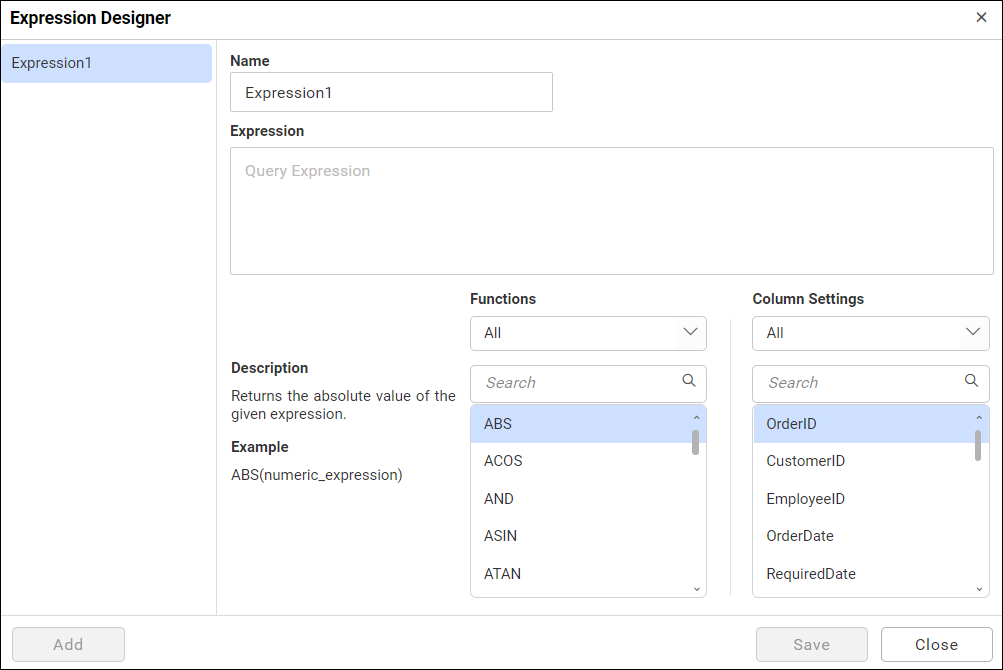
Enter a suitable name for the expression in the Name text area. By default, it will be Expression1.
Enter the expression that you like to define in the Expression text area.
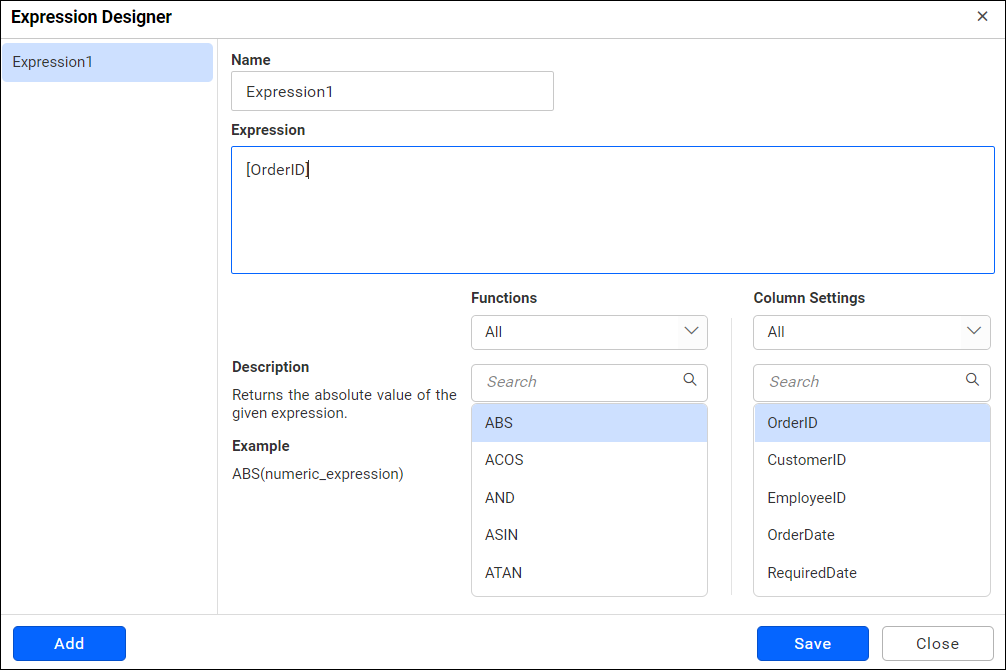
The syntax for defining a simple expression is,
{function name(}[columnname]{operator[columnname]…}
Where, content within curly braces is optional.
Some expressions for reference:
-
YEAR([Order Date]) – To compute year of order date.
-
COUNTD([EmployeeID]) – To compute distinct count of employees.
-
[Freight]+100 – To compute the total with 100 added to Freight.
Following built-in functions are supported in Expression Designer.
You can explore about each expressions detail here,Deleting an expression column
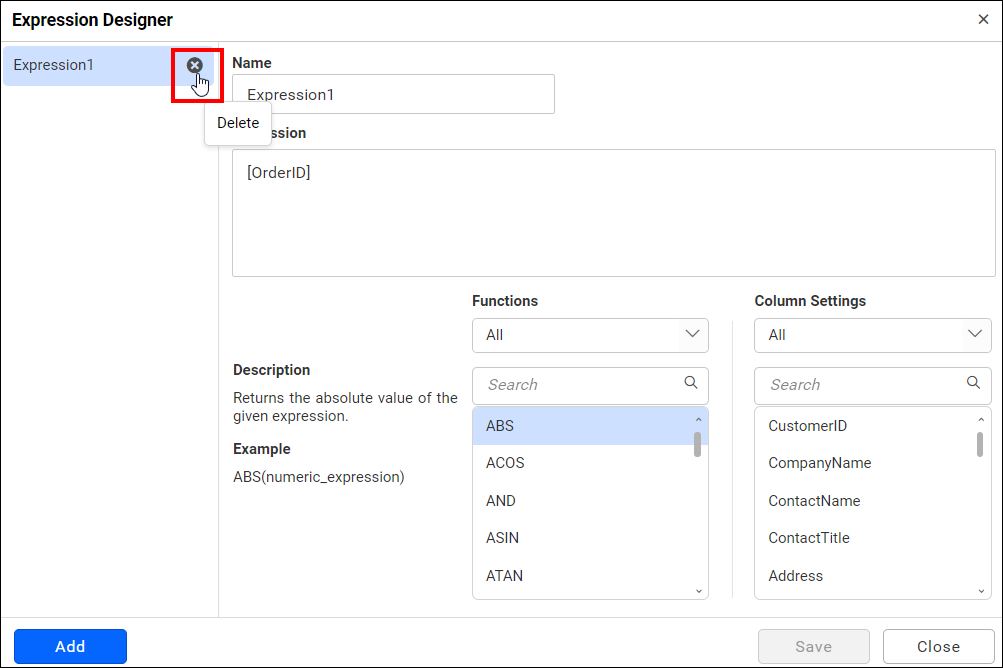
Select an expression column in left pane.
Click Delete icon to remove the selected expression column.
Updating an expression column
Select an expression column in left pane that you need to update.
Edit the Name and Expression text areas, if required.
Click Save in Query Expression window to save the modifications handled.
Configuring expression column in widgets
Saved measure expression will be shown in Measure Columns section of ASSIGN DATA tab like below.
Saved dimension expression will be shown in Dimension Columns section of ASSIGN DATA tab like below.
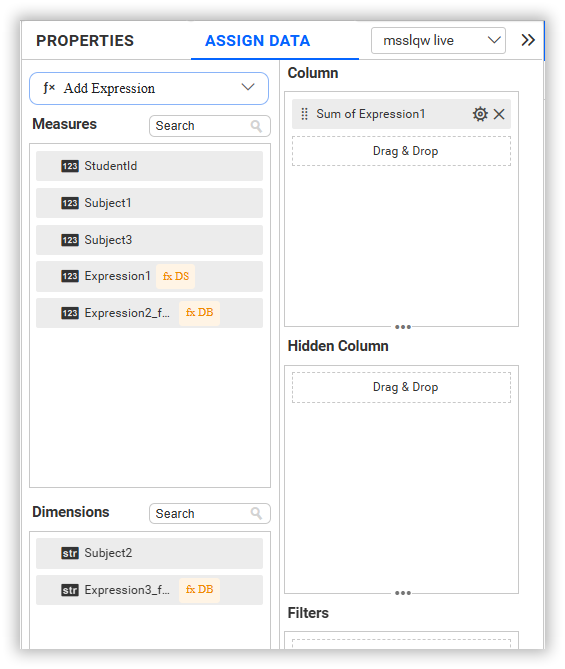
You can also drag and drop expression column into widgets from measure or dimension fields or both.
You can also apply filters for expression column which is used in widget. For numeric expressions, you can apply filter just like a measure filter. For string and date expressions, you can apply filter just like a dimension filter.
Related Links
Blog Post - Using Calculated Fields in Your Dashboard