
Bold BI Dashboards embedding in Windows Forms using Embed SDK
A GitHub link has been provided to get the sample application, which demonstrates the rendering of dashboard available in your Bold BI server and followed by steps to create a new embedding application in the Windows Forms on your own.
NOTE: The best way to get started would be to read the Getting Started section of the documentation first. The
Getting Startedguide provides you with enough information that you need to know before working on the sample.
Prerequisites
How to run the sample
-
Please get the Windows Forms sample.
-
Please ensure that you have enabled embed authentication on the
embed settingssettings page. If it is not currently enabled, please refer to the provided image or detailed instructions to enable it.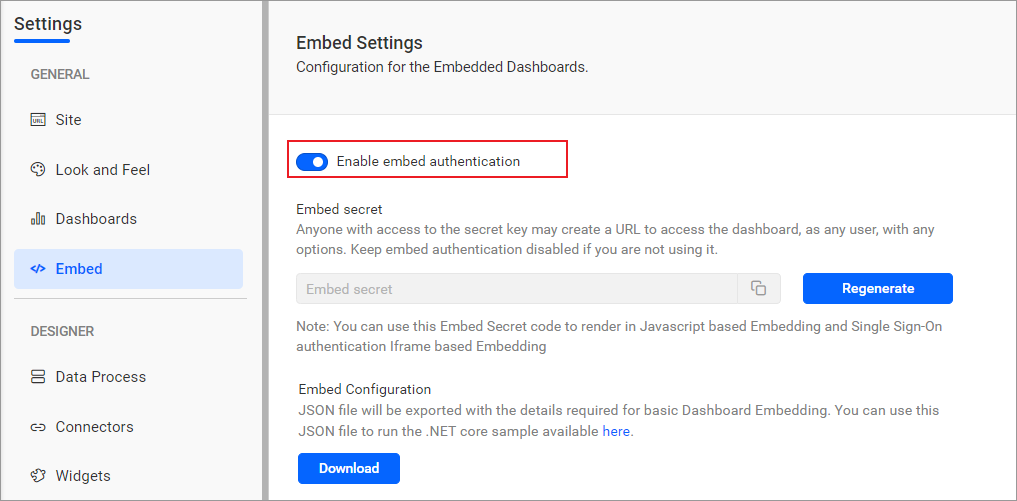
-
To download the
embedConfig.jsonfile, please follow this link for reference. Additionally, you can refer to the image below for visual guidance.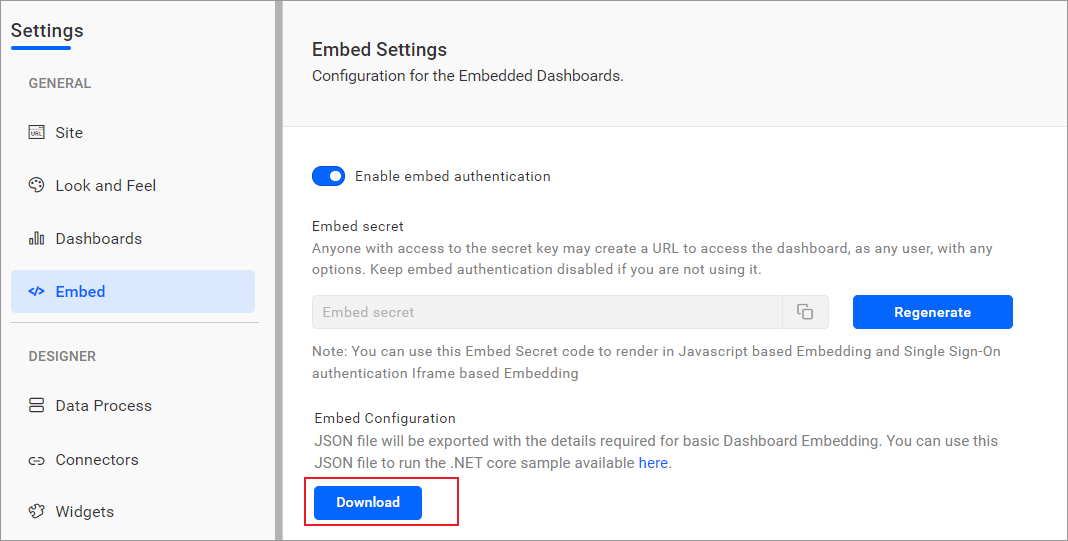
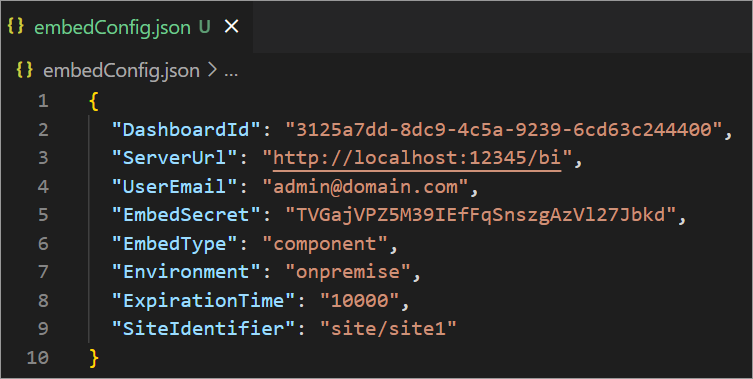
-
Please copy the downloaded
embedConfig.jsonfile and paste it into the designated location within the application. Make sure that you have placed it correctly in the application, as shown in the image.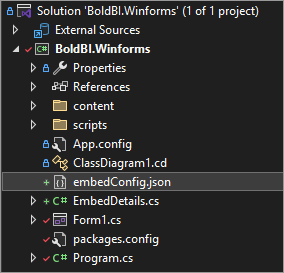
| ServerUrl | Dashboard Server BI URL (ex: http://localhost:5000/bi, https://demo.boldbi.com/bi) |
| SiteIdentifier | For the Bold BI Enterprise edition, it should be like site/site1. For Bold BI Cloud, it should be an empty string. |
| UserEmail | UserEmail of the Admin in your Bold BI, which would be used to get the dashboard list. |
| EmbedSecret | Get your EmbedSecret key from the Embed tab by enabling the Enable embed authentication in the Administration page |
| Environment | Your Bold BI application environment. (If it is a cloud analytics server, use `BoldBI.Environment.Cloud`; if it is your server, use `BoldBI.Environment.Enterprise`) |
| DashboardId | Item ID of the dashboard to be embedded in your application. |
| ExpirationTime | Token expiration time. (In the EmbedConfig.json file, the default token expiration time is 10000 seconds) |
- Then, run your Windows Forms sample.
How this sample works
-
To generate an access token, call the
GetEmbedDetailsAPI with the providedembedConfigvalues inembedDetails.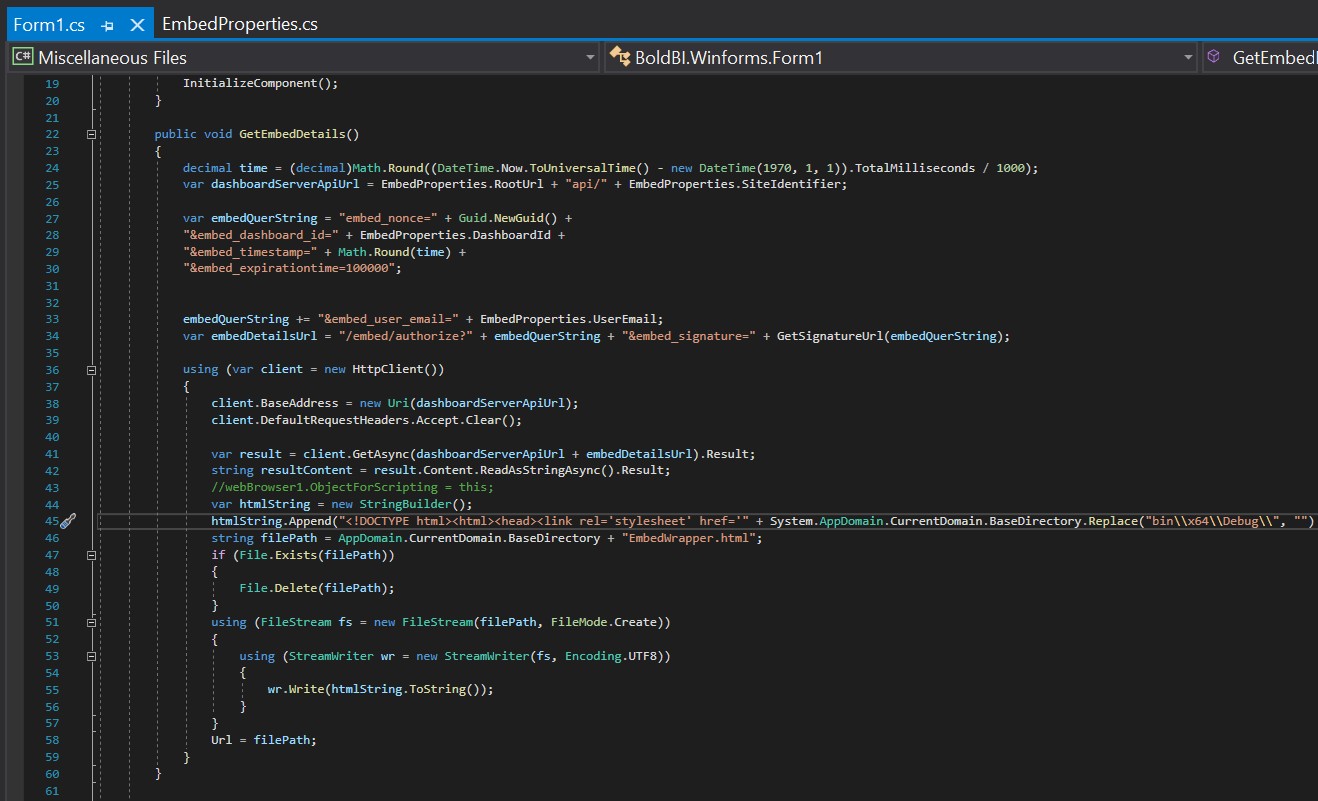
-
Once the token is generated, it will be append to the htmlString and the dashboard will start to render it.
    var htmlString = new StringBuilder();
    var serverUrlForJs = EmbedConfigProvider.Current.ServerUrl.TrimEnd('/') + "/" + EmbedConfigProvider.Current.SiteIdentifier;
    var environment = EmbedConfigProvider.Current.Environment;

    var cssPath = System.AppDomain.CurrentDomain.BaseDirectory.Replace("bin\\x64\\Debug\\", "") + "content\\chromium.css";
    htmlString.Append("<!DOCTYPE html><html><head><link rel='stylesheet' href='" + cssPath + "'/><script type='text/javascript' src='https://cdnjs.cloudflare.com/ajax/libs/jquery/3.6.0/jquery.min.js'></script><script src='https://cdn.polyfill.io/v2/polyfill.min.js'></script><script type='text/javascript' src='https://cdn.boldbi.com/embedded-sdk/latest/boldbi-embed.js'></script>");

    // Use JsonConvert.ToString(accessToken) to ensure the token is properly escaped as a JS string literal
    htmlString.Append("<script type='text/javascript'>$(document).ready(function() {this.dashboard = BoldBI.create({ serverUrl:'" + serverUrlForJs + "', dashboardId:'" + EmbedConfigProvider.Current.DashboardId + "', embedContainerId: 'dashboard', embedToken: " + JsonConvert.ToString(accessToken) + ", environment:'" + environment + "', width: window.innerWidth - 20 + 'px', height: window.innerHeight - 20 + 'px' "  + "}); this.dashboard.loadDashboard(); });</script></head><body style='background-color: white'><div id ='viewer-section' style='background-color: white'><div id ='dashboard'></div></div></body></html>");
Steps to create new Windows Forms application to embed dashboard
-
Start Visual Studio and click on
Create a new project. -
Choose Windows Forms Application (.NET Framework), then click
Next.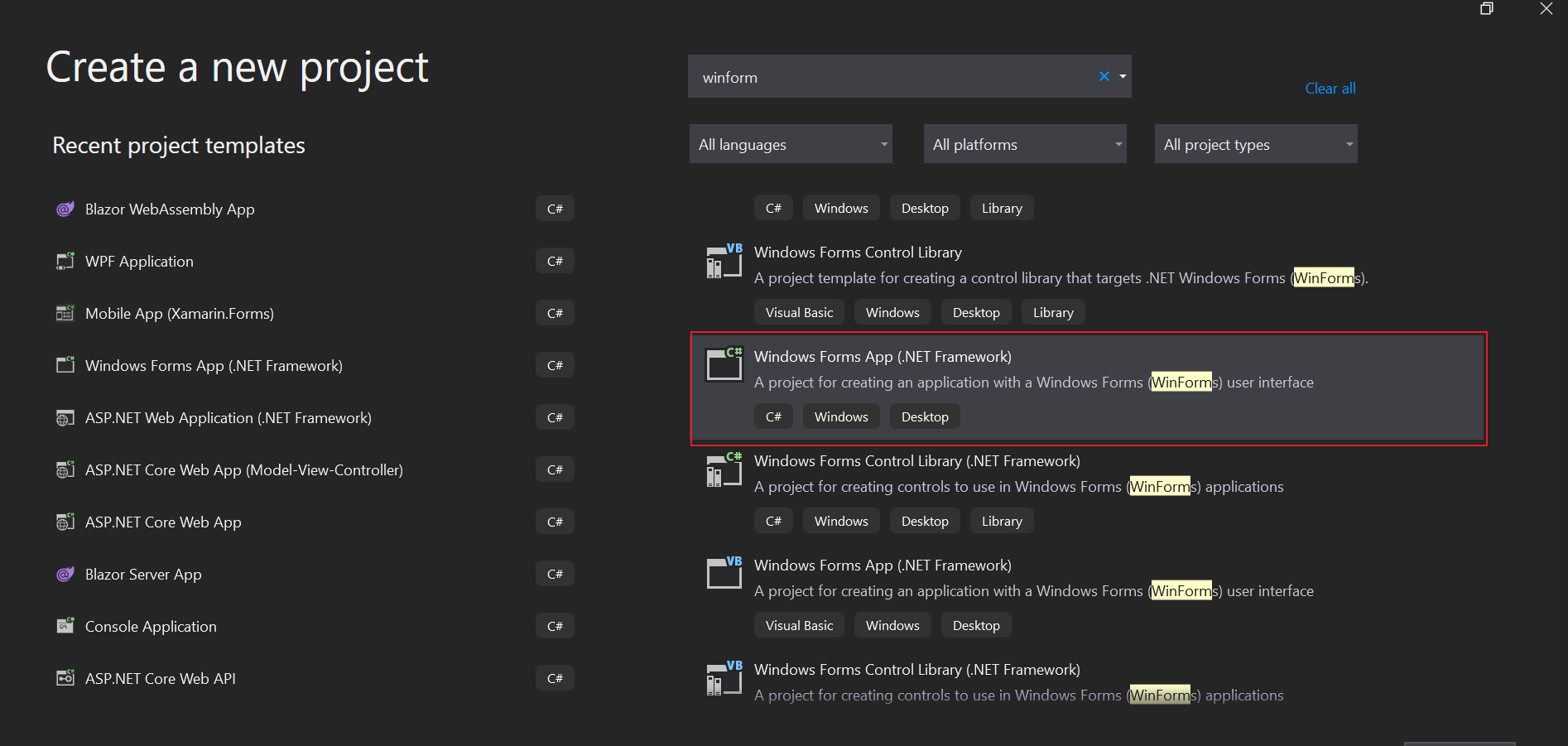
-
Change the project name as you want, then click
Create. -
Create a script folder in the project and add the latest
EmbedWrapper.jsin it. -
Create the model class
EmbedProperties.cswithin the project, and include the following code.internal class EmbedProperties { public static string RootUrl = "http://localhost:64503/bi/";//Dashboard Server BI URL (ex: http://localhost:5000/bi/site/site1, http://demo.boldbi.com/bi/site/site1) public static string SiteIdentifier = "site/site1";//For Bold BI Enterprise edition, it should be like site/site1. For Bold BI Cloud, it should be empty string. public static string Environment = "enterprise";//Your Bold BI application environment. (If Cloud, you should use Cloud, if Enterprise, you should use OnPremise) public static string EmbedType = "component";//Your Embedding type. If you are embedding as component, you should set 'component', if your are embedding as ifrmae, you should set 'iframe' public static string DashboardId = "enter dashboard id here";//Set the item id of the dashboard to embed from BI server. public static string UserEmail = "enter user email here";//UserEmail of the Admin in your Bold BI, which would be used to authorize the server. public static string EmbedSecret = "enter embed secret here";//You could get your EmbedSecret key from Embed tab by enabling Enable embed authentication in Administration page. } -
In the
Forms.cs, define the APIGetDetails(), which uses the methodGetSignatureUrl()to generate the algorithm. In this API, theembedQuerString,userEmail, and the value from theGetSignatureUrl()method are appended as query parameters in the URL to get details of a particular dashboard.public string Url { get; set; } public Form1() { this.Size = Screen.PrimaryScreen.WorkingArea.Size; this.WindowState = FormWindowState.Maximized; GetEmbedDetails(); InitializeComponent(); } public void GetEmbedDetails() { decimal time = (decimal)Math.Round((DateTime.Now.ToUniversalTime() - new DateTime(1970, 1, 1)).TotalMilliseconds / 1000); var dashboardServerApiUrl = EmbedProperties.RootUrl + "api/" + EmbedProperties.SiteIdentifier; var embedQuerString = "embed_nonce=" + Guid.NewGuid() + "&embed_dashboard_id=" + EmbedProperties.DashboardId + "&embed_timestamp=" + Math.Round(time) + "&embed_expirationtime=100000"; embedQuerString += "&embed_user_email=" + EmbedProperties.UserEmail; var embedDetailsUrl = "/embed/authorize?" + embedQuerString + "&embed_signature=" + GetSignatureUrl(embedQuerString); using (var client = new HttpClient()) { client.BaseAddress = new Uri(dashboardServerApiUrl); client.DefaultRequestHeaders.Accept.Clear(); var result = client.GetAsync(dashboardServerApiUrl + embedDetailsUrl).Result; string resultContent = result.Content.ReadAsStringAsync().Result; //webBrowser1.ObjectForScripting = this; var htmlString = new StringBuilder(); htmlString.Append("<!DOCTYPE html><html><head><link rel='stylesheet' href='" + System.AppDomain.CurrentDomain.BaseDirectory.Replace("bin\\x64\\Debug\\", "") + "content\\chromium.css'/><script type='text/javascript' src='https://cdnjs.cloudflare.com/ajax/libs/jquery/3.6.0/jquery.min.js'></script><script src='https://cdn.polyfill.io/v2/polyfill.min.js'></script><script type='text/javascript' src='" + System.AppDomain.CurrentDomain.BaseDirectory.Replace("bin\\x64\\Debug\\", "") + "scripts\\EmbedBiWrapper.js'></script></script><script type='text/javascript'>$(document).ready(function() {this.dashboard = BoldBI.create({ serverUrl:'" + EmbedProperties.RootUrl + EmbedProperties.SiteIdentifier + "', dashboardId:'" + EmbedProperties.DashboardId + "',embedContainerId: 'dashboard',embedType:'" + BoldBI.EmbedType.Component + "',environment:'" + BoldBI.Environment.Enterprise, /* If Cloud, you should use BoldBI.Environment.Cloud */ + "'mode: '" + BoldBI.Mode.View + "',width: window.innerWidth - 20 + 'px',height: window.innerHeight - 20 + 'px',expirationTime: 100000,authorizationServer:{url: '', data:" + resultContent + "}});this.dashboard.loadDashboard();});</script></head><body style='background-color: white'><div id ='viewer-section' style='background-color: white'><div id ='dashboard'></div></div></body></html>"); if (File.Exists(filePath)) { File.Delete(filePath); } using (FileStream fs = new FileStream(filePath, FileMode.Create)) { using (StreamWriter wr = new StreamWriter(fs, Encoding.UTF8)) { wr.Write(htmlString.ToString()); } } Url = filePath; } } public string GetSignatureUrl(string message) { var encoding = new System.Text.UTF8Encoding(); var keyBytes = encoding.GetBytes(EmbedProperties.EmbedSecret); var messageBytes = encoding.GetBytes(message); using (var hmacsha1 = new HMACSHA256(keyBytes)) { var hashMessage = hmacsha1.ComputeHash(messageBytes); return Convert.ToBase64String(hashMessage); } } -
In the above authorization, the
SignatureUrlhas been generated with the providedEmbedSecretkey and the embed details have been validated in Bold BI. Once the details are validated, the dashboard will start rendering. -
In the
EmbedProperties.csfile, you can change the dashboard Id of the respective dashboard as desired for embedding. -
In the
htmlStringvariable, please append the mandatory script files and a function that creates an instance to call theLoadDashboard()and render the dashboard.